GRE Prep
Stop Racing to Finish the GRE

You're in the second quant section of the GRE. When you started, you had 15 questions to complete and 26:00 on the clock. But you got lost in the sauce and now as you're trying to wrap up question 9, you look up to see that you've got 8:03 to go and 6 questions left.
You know how to do the remaining questions. But you also just spent 4:37 on one coordinate geometry problem, and you're still not sure about your answer.
You take a breath, click D and start sprinting. You feel adrenaline pumping as you fly through the last six, doing your best to visualize complex equations in the air. You get over your head partway through two of them and click random answers. On a third you confidently click the answer to a question that wasn't quite the one being asked. When you see a disappointing score at the end, there is a clear lesson.
I just need to get faster. I could ace this if I was just a little quicker!
That's the wrong lesson.
The key to GRE time management does not involve going faster. Stop racing to finish. Choose the test that you have time to finish and ace that one, and do not worry about the fact that there are some questions it excludes.
Why You Run Out of Time on the GRE
Three things are true of nearly every section you'll see:
- A few questions will eat you for lunch. Every section has at least two or three problems that are genuinely hard to get right, with or without rushing. They'll need 3 to 4 minutes out of you and in the end there is still a good chance you may get them wrong.
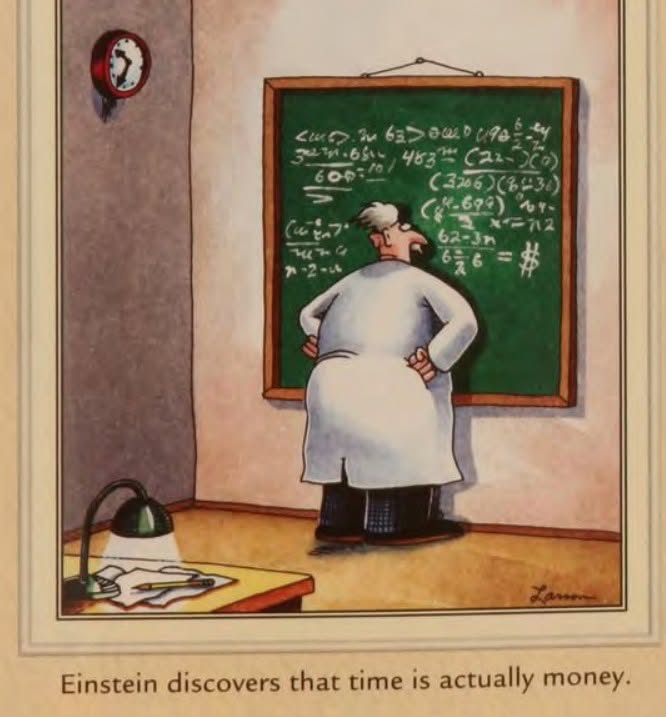
- The biggest drag on performance is time spent on questions you end up missing. I think it was Einstein who said that "time is money"1 and so I'll use those two concepts interchangeably here. Spending minutes of your valuable time and getting absolutely nothing in return is the worst deal on the GRE. Getting any single question wrong quickly is never a big deal, so long as you don't spend a lot on it. Spending 4+ minutes on a single question can immediately sink your ship.
- The shortest path toward a better score is to pick up the points that are already on the table. You likely have at least one problem that you could have easily solved but didn't, in part because you took it for granted and were racing to get to other questions.
The way to stop running out of time on the GRE doesn't involve moving more quickly (though it may involve moving more efficiently — watch for upcoming articles on building efficient habits). The key is to make smarter, more informed and more intentional choices about where to spend your valuable time.
Indulge me in a somewhat extended analogy to explain what I mean, or just skip to the practical part.
A GRE Timing Analogy: Six Errands, One Hour, and Three Strategies
It's 4:00 on a Friday. Your in-laws will get dropped off at your house at 5:00 for a new ritual: weekly dinner! You are standing in front of a commercial strip holding a post-it note that has the following list scrawled on it in Sharpie.
- Pick up the cake
- Get the tacos for dinner
- Mail an important package
- Pick up your prescription
- Get a spare key cut
- Pick up fresh flowers for the kitchen table
Everything on this list is important. So you get started immediately.
Attempt One: No Time to Waste
| Time | What's happening |
|---|---|
| 4:00 | Bakery. Counter is empty. Cake is boxed and waiting. You peek inside and it looks great, with the message "So Glad We Can Do This Every Week" in perfect gray script that screams sincerity. |
| 4:04 | Taqueria. Line out the door. But you get in it and wait. Picked up successfully when your time arrives. |
| 4:13 | Post office. Seven people, one clerk, and a man at the window mailing what appears to be a piano. You get in line, looking nervously at your watch. |
| 4:26 | Still in line. You've moved up four spots. Leaving now would waste thirteen minutes and you're getting close. |
| 4:33 | Package mailed. You experience déjà vu, briefly thinking about a certain coordinate geometry problem. |
| 4:41 | Pharmacy. You make it to the front of the line, but insurance hasn't cleared the refill. You explain you've been taking it since 2019. The tech explains the concept of policies to you and says it will be ready in another 10 to 15 minutes. |
| 4:51 | Turns out that's looking more like the upper end of the range. You live 12 minutes away. You give up on the meds and remaining items and head home. |
| 5:03 | Home. Your mother-in-law is standing on the front steps with her suitcase and says "What took you so long? I've been waiting." Inside, your partner makes the hand signal for "Flowers?" and then "Keys?" and then "WTF?" |
Total Tally:
| Wins (3) | Losses (3) |
|---|---|
| Cake | Meds |
| Tacos | Flowers |
| Package | Keys |
It's easy to point fingers here. It's easy to imagine various wrong lessons from this, and you do both. Pointing at your partner, you say "can't they come at 6 next week" and "why don't you buy the flowers next time, since it's your dad who cares about them?" Actually, thinking better of it, you take a breath and say "Next time, 10 minutes per errand. That's the rule."
Attempt Two: Ten Minutes Per Stop
Next Friday you have the same unexplained need to complete the same six errands in the same one hour window. This increases your feelings of déjà vu.
| Time | What's happening |
|---|---|
| 4:00 | Bakery. Box is waiting for you on the counter. Grab it, shouting "thank you" as you mentally tick off one mark in the W column. |
| 4:03 | Taqueria. Tacos are ready. You fire off double finger guns — "pew pew, you're the best" — and tick off W number II. |
| 4:09 | Eleven minutes banked. #ahead |
| 4:09 | Post office. Same line as last week, but you're ahead now. Basking in your newfound wealth of time, you buckle in and wait. You can afford to. |
| 4:22 | Third in line. By your math, still on schedule. |
| 4:29 | Package mailed. Getting close to the benchmark but still ok. |
| 4:37 | Pharmacy. You reach the counter only to learn that somehow last week's update did nothing to speed the process. Somehow you must always wait another 15+ minutes. |
| 4:49 | The pharmacist puts up a ripped piece of cardboard reading BACK IN 5 MINUTES, and shoots you a look that says "No one is going to be back in five minutes." |
| 4:58 | Fuming, you begin scheming as you stare out the window. When you get the meds, you know just what to do next. |
| 5:01 | "Florist." Feeling rather clever, you rip up several flowers from the bed in front of the pharmacy, not noticing the security camera staring at you. |
| 5:04 | Technically you're late. But in reality, you're very late. Despite this, you're determined to have a key cut. You use the self-service machine in the parking lot and break several traffic laws on the way home. |
| 5:16 | Home, with all six stops behind you. You wonder whether this counts as progress. |
Preliminary Tally:
| Wins (6) | Losses (0) |
|---|---|
| Cake | (Unless you count being super late as a loss) |
| Tacos | |
| Package | |
| Meds | |
| Flowers | |
| Keys |
Your in-laws offer the first indication that it may not. "I was starting to get really worried about you! Is it safe for us to be standing here at this time of night?" You mention having trouble with the key copy but proudly offer it to them.
While they're learning that it doesn't actually fit in the lock, a man on a skateboard skids to a stop in the street and sprints up to you saying "Hi, I'm Gary." You look bemused and he adds, "I think that you have my cake." Opening the box, you see it says "Congratulations Gary!" rather than "Second Time is the Charm" as you had intended. You hand it over, asking whether he brought you yours. "Huh, that would have been smart," he says and looks like he means it. You shout "Congratulations Gary" as he jogs away, but you're not sure that you mean it.
Inside, your partner showcases unusual signing skills by managing to silently say "OMG! Did you steal those flowers from someone's yard?" to which you can honestly answer "oh no, definitely not." This leads you to draw the incorrect conclusion about the success of your flower sourcing.
Actual Total Tally:
| Wins (3) | Losses (3 — or 4 if you count being crazy late) |
|---|---|
| Tacos | Wrong Cake |
| Package | Wrong Flowers |
| Meds | Wrong Key |
You might wonder whether it's even realistic to allow yourself to be 16 minutes late in a situation analogous to the GRE. No. It isn't. But the analogy holds up otherwise.
- The benchmarks were doomed from the start because they didn't leave time for the drive home. The perfect plan has a built-in cushion, and doesn't leave out the little stuff that adds up.
- Being ahead of your benchmarks doesn't mean timing has stopped mattering: you need to always stay efficient.
- The eleven banked minutes after two tasks wasn't real savings; you rushed and hurt your accuracy to get it, and you shouldn't have spent it unless you knew you were really getting enough in return.
- The stops you rushed are exactly the ones that fell apart. Your pacing plan technically allowed you to attempt all six tasks, but that didn't actually help you improve performance.
They say that the third time is the charm, and after reflecting on your issues, you make a plan to make that aphorism come true on your next attempt.
Attempt Three: Consider Before Committing
Don't blindly try everything and then give up. Make smart, realistic choices.
| Time | What's happening |
|---|---|
| 4:00 | Bakery. Counter is empty. Go, and check the writing before you leave, because Gary. Just as intended, it reads "It's Friday Already?" |
| 4:04 | Taqueria. Line out the door, but you confidently enter it anyway. You know how fast they move people through this place. The guy behind the counter draws his own finger guns and says "Pew pew! You got this!" |
| 4:13 | Post office. Also a line. You know this one — twenty minutes, both times, which is about what the cake, tacos, key and flowers cost put together. And you haven't touched any of them yet. The package can wait. |
| 4:14 | Pharmacy. You pause briefly outside to consider whether they may have resolved the insurance issue. Then you remember how the world works, laugh quietly to yourself for your foolish optimism, and move on. |
| 4:15 | Feeling a weight lifted off your shoulders, you stop staring down and mindlessly sprinting forward. You look around and you start to see alternatives. Maybe I don't need to use the busted self-copy machine or the place inside the giant lumber yard that always takes forever. You remember about a little kiosk right next to the florist, in the corner beside the market. You turn left — it's a straight shot. Moments later the key is copied. |
| 4:19 | Florist. Sometimes you get a busted, ugly bouquet when you're rushing, and your in-laws judge you. Without drawing it out more than is necessary, you still take the time to look over the flowers before buying and do it right. |
| 4:27 | Now that you've finished everything easily doable, you think about what remains. You know you'll need 12 minutes to get home, so you only have 21 minutes left. That should be enough time to make the pharmacy work, but you know how unreliable that place is, so there is no guarantee, and it still makes you nervous. It should be enough time for the post office you used last week, but it is cutting it awfully close. Then you remember you'd been asking around and found another post office that seems much quicker. You head over there to drop off the package. |
| 4:42 | This place really is a lot faster. You're going to have to remember to use this post office in the future. You've still got a little time to spare, so you look back over the list just to make sure you didn't miss anything. You know better than to even try for the pharmacy, so instead you head home. |
| 4:54 | You arrive home with a few minutes to spare. You test the key in the lock, and are pleased to confirm that it works before time runs out. You get the flowers arranged nicely (presentation matters!) and display the cake in a prominent spot. You brush your teeth for the first time in an undisclosed number of days, fix your hair, and are at the curb waiting when your in-laws arrive. |
| 5:00 | Your mother-in-law says "Oh thank goodness you finally picked up on our subtle hints about GRE timing! Can we stop coming over here for dinner once a week now? It's been such a hassle and honestly I feel like I've seen enough of you folks to last me a year." |
It's hard to express how many levels of relief that offers.
Final Tally:
| Wins (5) | Losses (1) |
|---|---|
| Cake | Meds |
| Tacos | |
| Package | |
| Flowers | |
| Keys |
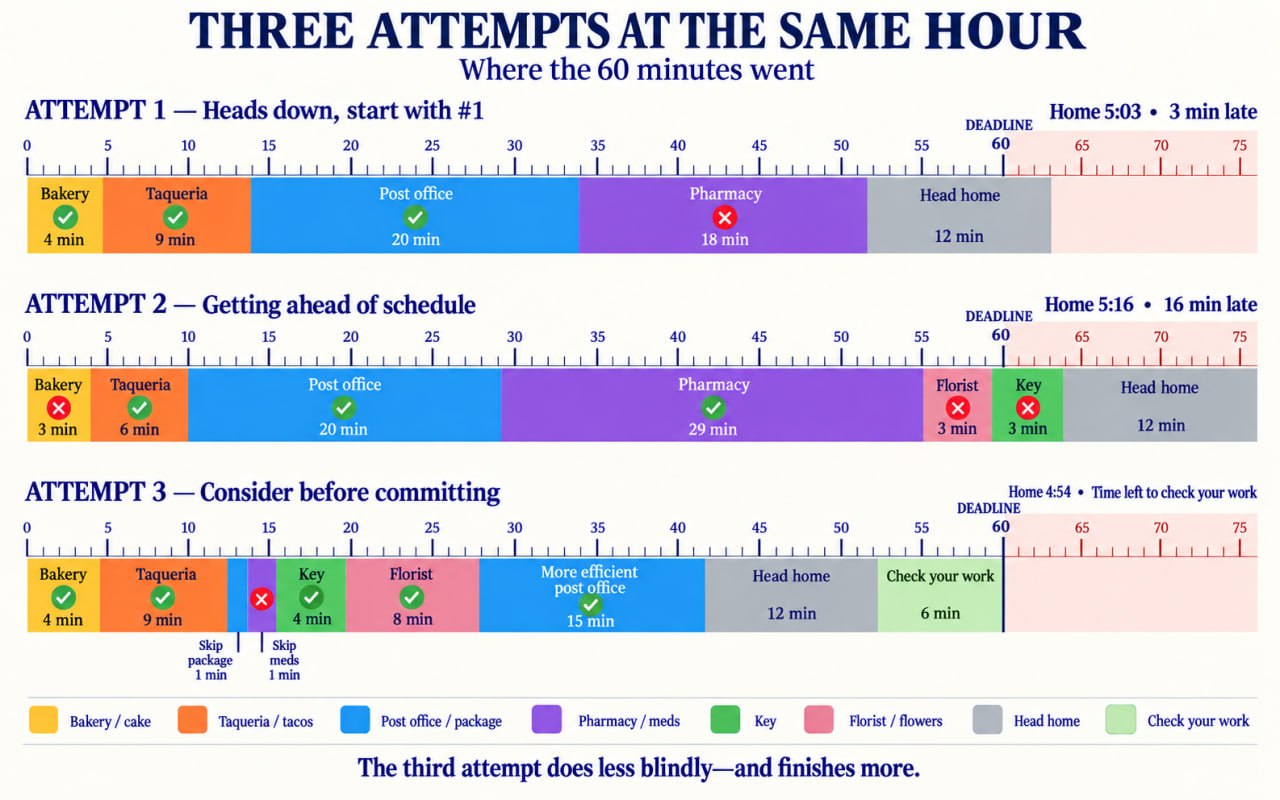
GRE Strategy Takeaways: What the Errands Teach About Test Timing
What worked above is what works on the test: Rather than allowing the biggest challenges on the list to dominate your time, you confidently strode by them and said, "Not Today!"
- The bakery (cake): Picking up the cake should be easy so long as you give yourself 20 seconds to avoid a careless/avoidable error. Don't take these for granted.
- The taqueria (tacos): The taco line sometimes was long, but that doesn't mean you should always skip it: sometimes if you're familiar enough with a kind of problem, you know that you'll be able to solve it quickly even if it has several steps. Confidence from experience.
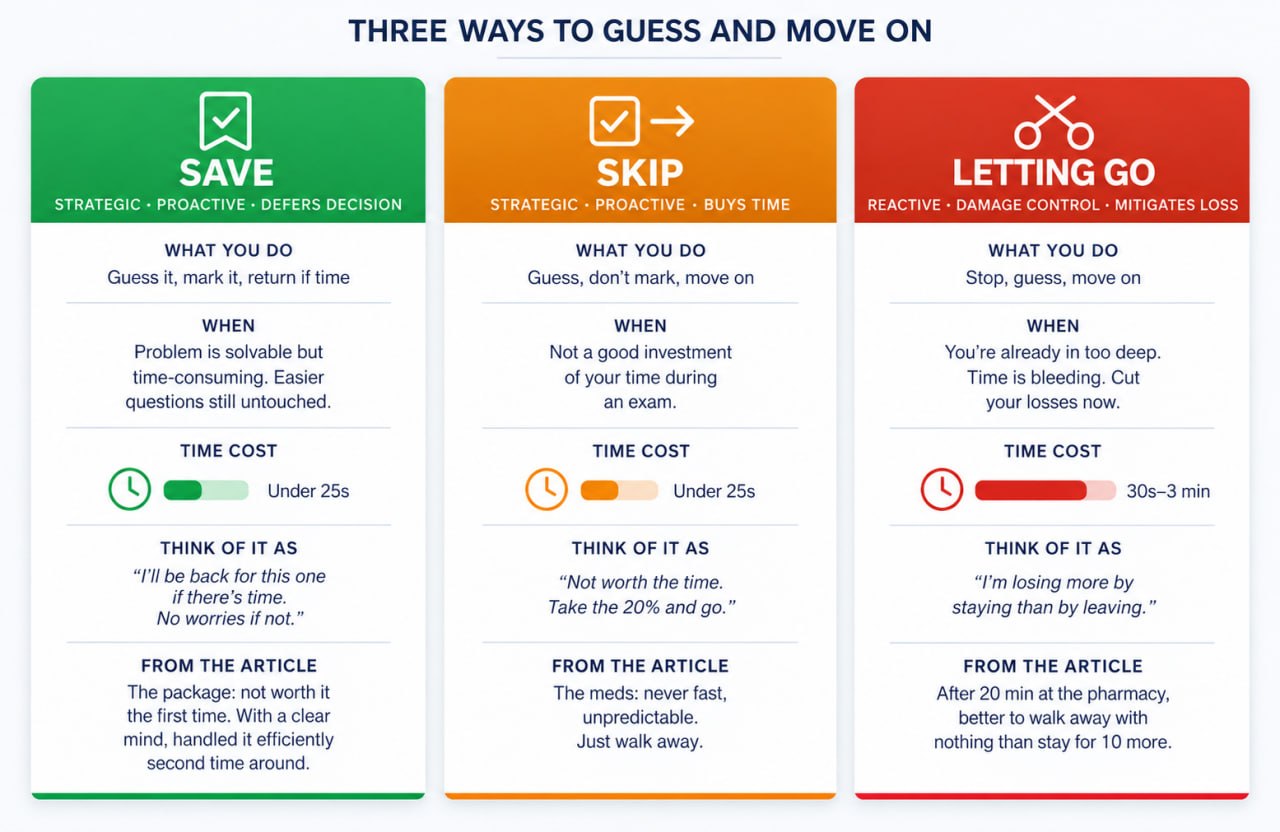
- The post office (package): Mailing the package was the classic trap of getting stuck, early, in a long process just because you know you'll eventually get to the end of it; a SAVE uses the GRE's mark tool as a great way to set aside a problem that you know you can solve if you've got time, but you also know might take so much time that you miss several others that were shorter. These are great questions to come back to early in the second pass.
- The pharmacy (meds): The prescription was the best option to sacrifice entirely: not only does it drain so much time that the rest of the test becomes a scramble, it also might never get done. This is your SKIP.
- The key and flowers: The keys and flowers were not hard tasks, they just got stuck at the tail end of the section in a way that means failure to prioritize could easily let them go wrong rather than picking up some easy credit. Remember, on the actual GRE you get the same credit for each correct response in a section, so they're worth just as much as the prescription and the package but take far less time.
- Looking up and finding a better post office: The whole process of prioritization can allow you to clear your head a bit and look up, rather than just looking down and grinding forward; in this case, it turns out that there was another way to approach mailing the package that was far more efficient when you were able to come back to it with enough time.
The Two Most Important Tools of GRE Time Management: How to SKIP and SAVE
When a student tells me they skipped 3 questions, I always check their exam before taking them at face value. Often they have actually "taken a few swings" at the problem and then abandoned it, and this doesn't serve the function I'm describing.
A real SAVE or SKIP is a decision to not even start solving the problem the first time that you see it.
Either one takes 30 seconds maximum and happens before you write anything down, often before you've fully read the problem. Both begin by putting an answer in, since there's no penalty for a wrong answer on the GRE and a blank is a pure loss if you never make it back. The difference is what follows. When you SAVE a question, you guess, mark it, and move on planning to return — that's the package. When you SKIP one, you guess and move on without marking it, and you don't plan to return — that's the meds.
Spending a minute or more on a problem and then giving up is neither, and it doesn't buy you the time that you need. If a problem really is hopeless, it may be worth LETTING GO rather than allowing it to swallow all of your time and leave you scrambling through everything else, but that is a reactive move to prevent a worse loss — not a strategic, pro-active move that builds you a better score.
Remember that SAVEs and SKIPs are not reserved for problems that you cannot solve. They are strategic plays for problems that you should not allow yourself to get sucked into too early, because they are likely to run a bit slower, or to give you more trouble than your average. And because you can move freely within a GRE section and return to any question until time expires, you can always use a SAVE if you're struggling to permanently let go of a question, so long as you don't rush through other questions just to make sure you've got time for it at the end.
GRE Timing Strategy Recap: Attempt Fewer, Score Higher
The best GRE timing strategy is to bend the exam to work for you, rather than bending yourself to the exam. Don't focus on going fast enough to complete the questions someone else selected, but instead select the questions that you can solve fast enough. It is counterintuitive, but I have worked with thousands of students who can attest that it works.
This is not surrender. It's the thing I said at the top — choose the test you have time to finish and ace that one. This is about taking the easy wins before you worry about gambling on the longer shots. It's about being willing to sacrifice a few of the investments that were least likely to pan out anyway in order to make sure you lock in the great returns offered on all the rest.
Rather than running through long timed sets at full speed aiming to shave a few seconds by cutting corners and risking careless errors, you want to focus on the skills and habits that allow you to get full credit for what you already know. The steps are simple:
- Learn to recognize the ones you know you have time to get right
- Take that time
- Get them right
You can always go back to questions on the GRE, so there is no reason to tackle a tough, time consuming question the first time you see it. The shortest path to a better score always starts with the points you're currently leaving on the table. If you're still losing any problems to careless errors driven in part by stress and speed, pushing your pace to get time for even more questions will not help.
Get the TestCrackers GRE Pacing Guide
Stay tuned for subsequent articles with more details on exam strategy, the two-pass system, habits that keep careless errors from undoing all of it, and more.
If you want a free detailed section-by-section pacing guide now, just fill this out and we'll share it with you.
Seth Capron has spent over 12 years teaching the GRE and helped thousands of students score their best and get into graduate school. He's a 99th percentile scorer on the GRE, GMAT, and EA, and has hundreds of five-star reviews from students. He's authored a number of articles for mba.com on exam strategy and holds an MBA from the Kellogg School of Management. He designed the TestCrackers curricula with Yuri, and he will take the analogies in these articles far further than he has any right to.
Have questions or a topic you'd like Seth to write about? Email him.
- It wasn't, despite this cartoon. ↵
Ready to raise your score with 99th-percentile instructors? TestCrackers runs the highest-rated small-group GRE courses and 1-on-1 tutoring.
Explore GRE courses →