How to Study for the GRE

The most common questions about GRE study strategy — where to start, how to plan, and what mistakes to avoid — answered by TestCrackers' 99th-percentile instructors.
What is the best way to study for the GRE?
Follow the study cycle: learn content, practice problems, take a full practice test every two to three weeks, review that test in depth, and adjust your focus based on what the review tells you. The review step is where most of the real learning happens.
Daily consistency matters more than marathon sessions. Even 30 to 60 minutes every day is better than sporadic four-hour blocks. Use different-sized study blocks for different purposes: shorter blocks for focused problem sets and vocab, longer blocks for practice exams and deep review. Vocab in particular is ideal for squeezing into spare moments throughout the day.
The more constrained you are on time, the more important it is that every hour counts. Doing the wrong thing won't get you there no matter how many hours you put in. If you're not making the progress you want, the fix is usually to change what you're doing, not just to do more of it.
How do I make a GRE study plan?
Start with a diagnostic practice test (the free timed ETS PowerPrep) to identify your baseline. A study schedule depends completely on your starting score, goal score, strengths, weaknesses, and available daily time. We cannot lay out what you should be doing week by week without knowing your specific situation. Call us and we're happy to help you create one.
What should I study first for the GRE?
Start with a diagnostic test, then tackle your weakest area first. For most students, that means math foundations (if you're rusty) and vocabulary (if your verbal baseline is below your target). Strategy and pacing come later, once you have the underlying content knowledge to apply them.
How do I balance GRE content study with practice test cycles?
Content study and practice tests aren't either/or. Study content between practice tests, and after you've covered the basics across the board, use the test results to figure out which content to focus on next. Think of practice tests as diagnostic checkpoints that guide your study, and opportunities to build your comfort and skill at performing strategically under pressure, but not as the study itself.
What is the two-week study cycle?
Study content and do practice problems for about two weeks, then take a full practice test. Review the test thoroughly to identify your weakest areas, adjust your study plan, and repeat. This rhythm keeps you making steady progress without burning through practice tests too quickly.
What are the stages of GRE prep?
For quant, especially for students starting below about 154, GRE prep generally follows three stages:
Stage 1: Math foundations. Rebuilding core math skills can take anywhere from about four weeks to much longer, depending on your starting point.
Stage 2: GRE content and strategy. Learning question types, approaches, and GRE-specific content.
Stage 3: Timing strategy and refinement. Working on timed sets, pacing, and harder questions.
Throughout stages 2 and 3, take regular practice exams and use them to find and home in on your weak areas.
GRE for beginners — where do I start?
Take the free timed ETS PowerPrep practice test. This is your most important first step — it tells you exactly where you stand.
A critical detail: make sure you take the timed version. There is also an untimed PowerPrep test that is not scored and not computer-adaptive, and many students take it by mistake. The untimed version will not give you a meaningful baseline score. You need the timed, scored, adaptive practice test.
You can find the free PowerPrep practice tests on the ETS GRE Test Preparation page. Fair warning: ETS doesn't make them easy to find. The page leads with paid practice tests ($44.95 each). Scroll past those to the “Previous Editions & Free Prep” section near the bottom — that's where you'll find PowerPrep 1 (untimed) and PowerPrep 2 (timed) for $0.00. Add the timed one to your cart and check out. You'll need to create a free ETS account if you don't have one.
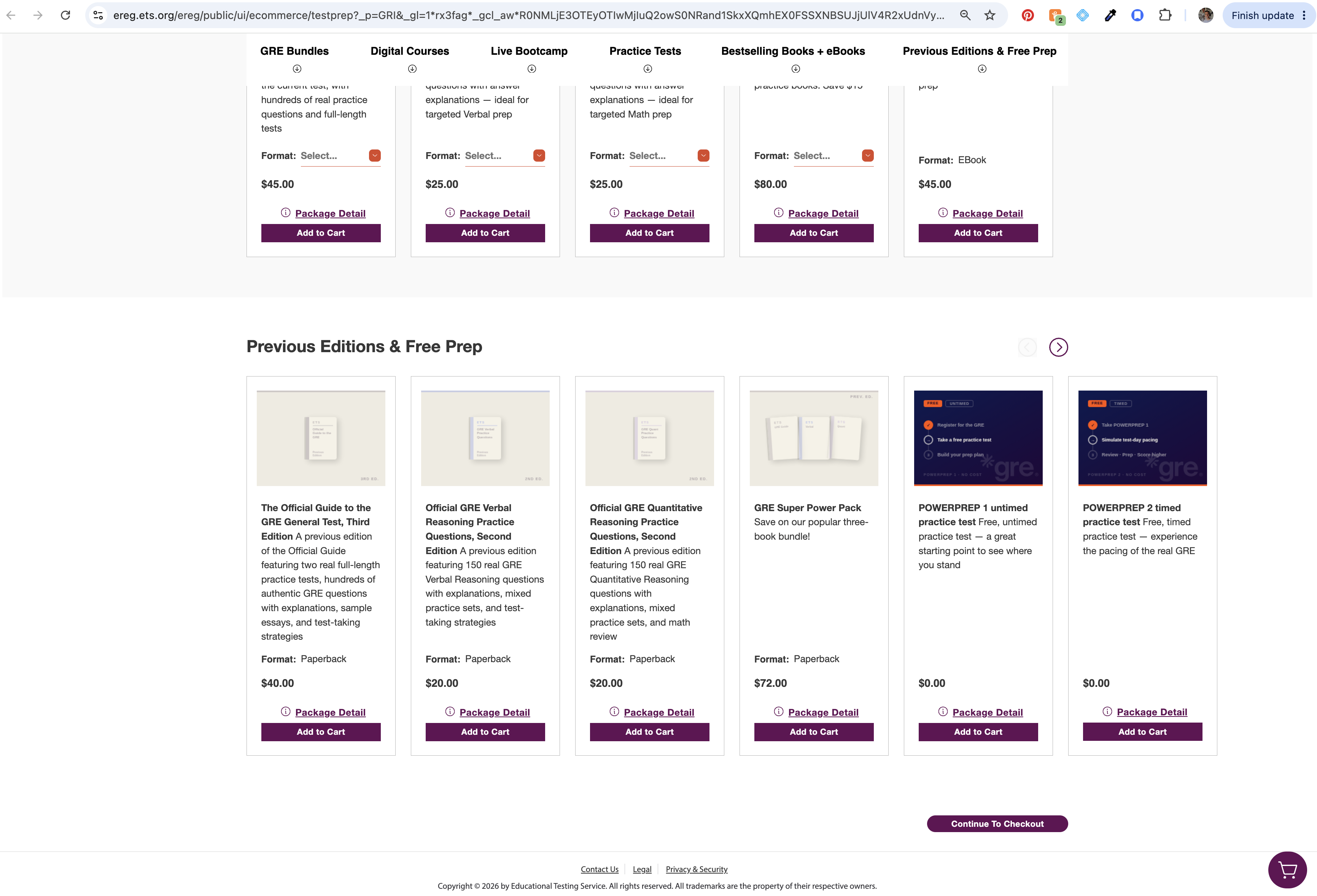
Your baseline score tells you where you're starting and what you need to focus on, which is essential for building an effective study plan. Without it, you're studying blind.
How do I prepare for the GRE at home?
Start with a diagnostic practice test to find your baseline and weaknesses. Then build a study plan that targets your weakest areas, mixing content review with a full practice test every 2 to 3 weeks. Use the free timed ETS PowerPrep test for realistic benchmarking, and study consistently over weeks rather than cramming in marathon sessions.
How do I create a GRE study plan for working professionals?
Same core principles as studying full-time, just built around your work schedule. About 1 to 1.5 hours per day on weekdays is realistic for most working professionals. Study before work if you can — many people find mornings more effective than evenings. Set weekly goals for what you'll accomplish, not just hours. Make sure your study time is fully distraction-free. Don't count commute time as study time (vocab flashcards being the exception). Make up additional hours on weekends. It will take longer than if you had more time — plan accordingly.
Can I self-study for the GRE or do I need a course/tutor?
Many students successfully self-study for the GRE using official ETS materials and a structured study plan. A course or tutor becomes valuable when you've plateaued and can't figure out why, when you need accountability, or when you're targeting a very high score and need expert guidance on strategy. Start with self-study and consider getting help if you stop seeing improvement.
How to prepare for the GRE from India / Nigeria / Bangladesh?
The GRE is the same test worldwide, so the prep approach is the same regardless of location. You can take the GRE at home or at a test center. Register through the ETS website (ets.org) and use ETS official practice materials. The at-home option is available in most countries and can be a great choice if test centers are far from you or have limited availability.
Can older/returning students do well on the GRE?
Absolutely. Returning students often have stronger reading comprehension and life experience that helps with the essay. The main challenge is usually rusty math, and that's fixable with the free ETS Math Review and focused practice. Many strong GRE performances come from people who've been out of school for years and approach their preparation seriously.
Should I focus on content knowledge or test strategy?
Both, in the right order. Content comes first because strategy can't help you if you don't understand the material. But you can't expect content gains to show up in your scores until your pacing and strategy click. A student with great content knowledge and poor strategy will underperform their ability every time. Build content, then layer on strategy to unlock what you know.
"I can cram for the GRE like a college exam"
The GRE tests reasoning skills and vocabulary you build over time, not facts you can memorize the night before. Cramming might create the illusion of progress, but it rarely translates to meaningful score improvement on a test designed to measure how you think under pressure. Consistent study over weeks produces better results than all-nighters.
Ready to raise your score with 99th-percentile instructors? TestCrackers runs the highest-rated small-group GRE courses and 1-on-1 tutoring.
Explore GRE courses →