GRE Prep
There is Only One Reasonable Way to Make the GRE vs. GMAT Decision

If you're applying to business school and you've spent more than twenty minutes trying to decide whether to take the GRE or the GMAT, you've probably noticed that the internet has a lot of opinions and not a lot of clarity. Some forums insist the GMAT is the only serious choice for MBA applicants. Others call the GRE the smarter strategic play. A troubling number will hand you a twelve-factor decision matrix that somehow makes the whole thing more confusing than it was when you started. Some of what you read is outdated or misinformed; some may have good information but bury it beneath a mound of unhelpful distractions.
Here is the short version: the best test for your application is the one on which you can produce the more competitive score. That is the whole answer. The rest of this article is about figuring out which one that is for you, specifically, given your strengths, your weaknesses, and the programs you're targeting. In recent years, it has been the GRE for an increasing number of students.
Pickleball and Tennis
A lot of people frame the GMAT as "hard mode" and the GRE as "easy mode," as though they're difficulty settings on the same video game. There's a grain of truth in it (GMAT quant questions, in particular, tend to be harder), but it's far too simple, and it leads to bad decisions.
Think of them more like pickleball and tennis. Both are racquet sports. Both are played on a court. The same things that make you good at one are fairly likely to help you be good at the other, and the same with the challenges. But they're not the same game, and some people who are only moderately good at one turn out to truly excel at the other. If you've never played before, I could tell you all kinds of information about each of them so that we could guess which one you'd be better at, but we'd still be guessing. A much better way to figure it out is for you to go out and play a little bit of each.
Pickleball has a reputation as the easier sport. In some ways it is: the court is smaller, the learning curve is gentler, the barrier to "pretty decent" is lower. But if you show up to a competitive pickleball tournament, that doesn't mean you're going to win easily. You are not just playing against beginners who couldn't hack it at tennis: you're playing against people who chose pickleball because it's the best fit for their abilities, and at that level, the game is pretty damn hard.
This is the part that matters for the GRE-vs.-GMAT question. At any given business school, the applicant pool is the same whether you submit a GRE score or a GMAT score. The admissions standards are the same. You're being evaluated against the same people for the same seats. It doesn't matter whether one test is "easier" in the abstract. What matters is which test gives you the more competitive score relative to the other applicants.
For some people, one sport really does stand out. They pick up a paddle and something clicks that never quite clicked with a racquet, or the other way around. For many people, either sport would work fine, and it's about which one they enjoy more and can learn faster, offering a shorter and more pleasant path towards playing competitively. And if you start one and it's not working, switching isn't the end of the world. The core skills transfer. Still, you should take a moment to figure out which sport is best for you before you buy all of the gear and start putting a ton of time into it.
The mapping, decoded once:
- The tournament = admissions at your target programs. Same applicant pool, same standards, regardless of which sport you play.
- Tennis = the GMAT. The traditional, established choice for MBA programs.
- Pickleball = the GRE. Often perceived as easier, but still fiercely competitive at the level that matters.
- "Go play" = take a practice test of each. Reading the rules and theorizing about this only gets you so far.
What's on the GRE and GMAT
Both tests measure quantitative reasoning, verbal reasoning, and your ability to interpret information under time pressure. That core overlap is why every top MBA program now accepts either one. But the specific skills each test rewards, the tools it provides, and the way it's structured differ in ways that affect your preparation and your performance.
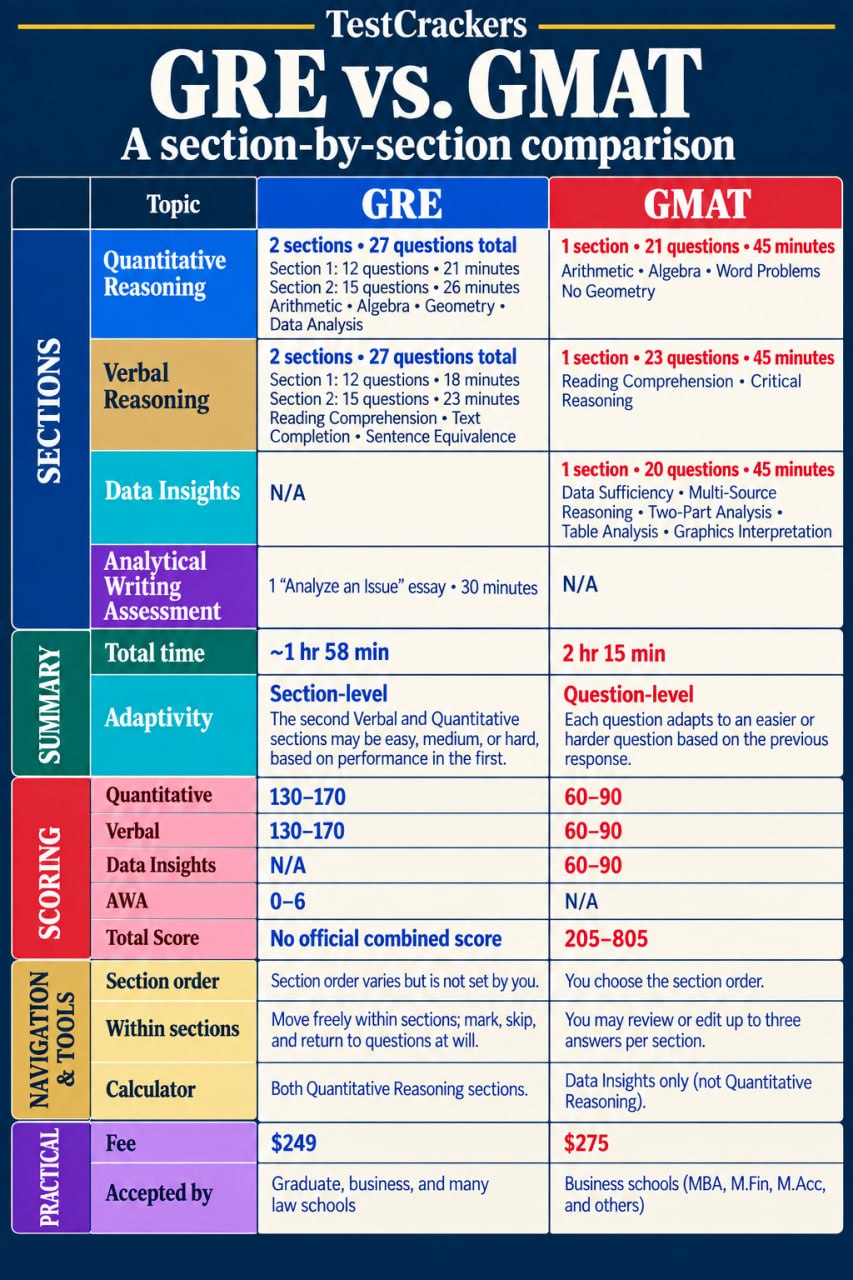
A few things from this table are worth calling out.
Data Insights is a full section on the GMAT. It has the same time allotment as Quant and Verbal (45 minutes each), it's scored on the same 60-90 scale, and it constitutes a third of your total score. Data Insights includes Data Sufficiency (which tests whether you can determine what information is necessary and sufficient to answer a question), Multi-Source Reasoning, Two-Part Analysis, Table Analysis, and Graphics Interpretation. If you've been thinking of the GMAT as a quant-and-verbal test with some data questions tacked on, you're underestimating a third of the exam.
The ability to use a calculator is a smaller difference than people think. The GMAT provides a calculator in Data Insights but not in Quant. The GRE provides one for all quant sections. On both tests, it is rare that using the clunky calculator provided (try the calculator simulator) is going to be worth the effort, because the math you're asked to do can generally be simplified and solved more quickly and effectively without it. On top of that, it can often make you less accurate because you don't have a record of what you entered and you can believe that the output is correct when you've misentered the input. Rather than relying on the calculator from the start, I push my students to train themselves to work without it, and most are able to surpass the calculator in speed and accuracy within a month of focused practice.
Adaptivity is one of the biggest practical differences. The GRE is section-adaptive: your performance on the first Verbal section determines the difficulty of the second Verbal section (same for Quant). The GMAT is question-adaptive: each question's difficulty adjusts based on your previous answers within that section. This affects the testing experience more than people expect. Most test-takers find the GMAT's question-by-question escalation more anxiety-inducing, though plenty of people find the GRE's "your second section is a verdict on your first section" structure stressful as well.
Because each one adapts, the first practice test you take might feel very different from how it looks when you begin to perform better and are served more difficult individual questions (on the GMAT) and more difficult second sections (on the GRE).
The GMAT dropped Geometry and Sentence Correction entirely. If someone is giving you advice based on a pre-2024 GMAT, they're describing a different exam. On the flip side, the GRE still tests geometry as well as vocabulary (through Text Completion and Sentence Equivalence questions).
Who Does the GRE Favor? Who Does the GMAT Favor?
I've been coaching students through this decision since it started to become more common for business schools to accept the GRE, and every year the percentage of students I see applying for an MBA with the GRE has gone up. The way that the schools view the exams has also shifted, to the point that they really do sit on equal footing. But the most important factor remains exactly the same: choose the exam that you'll score better on. And that tends to come down to a handful of concrete factors, not some grand analysis of your entire academic history.
The GMAT might be a good choice if you:
- Are particularly good at the Data Insights (DI) section. If you are significantly better at DI than one of the other (quant or verbal) sections, then you may benefit from a test that allows you to balance a weaker score in one of the two sections that both exams cover with a third section in which you excel.
- Struggle significantly with the GRE Verbal section. Quant comparisons between the two exams tend to point in one direction: the GMAT's is harder. But verbal really does go both ways. Some people naturally score better on one exam than the other. It is important to differentiate between situations in which the gap is entirely based on vocabulary versus other issues. If it's vocabulary, the GRE may still be your better bet, because vocab is something you can study and improve, and the GMAT doesn't offer a similar path to close a verbal gap. This point matters most when your GRE Verbal struggles go beyond vocabulary, or when you're unable or unwilling to put in the time to learn GRE vocab.
- Excel at standardized tests and perform well under pressure. If you've historically scored at the very top on tests like the SAT and you're confident you can execute on the GMAT's tougher questions, its difficulty isn't a barrier, and a top score will stand out. If standardized tests haven't been your strongest suit, you may get further with clean execution on the GRE.
- Are targeting business programs exclusively. MBA, Master of Finance, Master of Accounting, and similar. Other students might benefit from the option to use the GRE if they choose to apply to other dual degree, master's, PhD and JD programs, but if you are certain that you will not be doing this, that shouldn't matter to you.
The GRE might be a good choice if you:
- Have a strong vocabulary and start off with a very strong GRE Verbal score. Sentence Equivalence and Text Completion reward a wide, actively used vocabulary. If you've always been a reader and words tend to stick, GRE Verbal plays to that. Many of the same people who score well here will also score well on GMAT Verbal, but that isn't true for everyone. Since most people will have an easier time on GRE Quant than GMAT Quant, the question gets pretty simple if you're also going to perform better on the verbal side.
- Would accept broader math content in exchange for more approachable questions. The GRE covers arithmetic, algebra, geometry, and data analysis. If quant isn't your strong suit, the GRE is often the shorter path to getting comfortable, not the other way around.
- Want more flexibility during the test. Navigate freely within sections, skip questions and come back, manage your own pacing. For some test-takers, this meaningfully reduces errors and anxiety.
- May apply to programs beyond business school. The GRE is accepted by nearly all graduate programs (MBA, public policy, engineering, and more) and by many law schools. One test, one set of scores. See which programs accept the GRE vs. the GMAT
The simplest case
If a program you're applying to only accepts one test, take that test. As of this writing, every top-50 U.S. MBA program accepts both. The GRE has the broader reach: it covers business, graduate, and many law programs with a single score. Check program requirements
The Middle Path: The Executive Assessment
Any discussion of these two exams is incomplete without discussing the Executive Assessment (EA): a shorter version of the GMAT with a format more similar to that of the GRE, originally used exclusively for Executive MBA programs but increasingly accepted at full-time MBA programs as well. As of this writing, GMAC or the schools themselves list it for the full-time MBA at 19 of the top 30 programs, including Columbia, Darden, Stern, UCLA, McCombs, Fuqua, and Tepper. If the EA isn't accepted at your target programs, skip ahead to the next section (and if you're not sure, the EA program acceptance list can be a good starting point). But if it is, then this could well be a smart strategic move.
Many people find the EA the most approachable of the three, and some reach a competitive score with far less prep time than the others require. But it still has a wide range of content: it split off from the "classic" GMAT earlier and so it contains nearly all the topics from that earlier version (including Sentence Correction), whereas the current GMAT has a somewhat narrower focus. Like the current edition of the GMAT, the EA is split into three sections, but unlike the current GMAT, it uses "stage adaptation" rather than question adaptation, and the topics are divided up somewhat differently. Here is the basic story of that evolution:
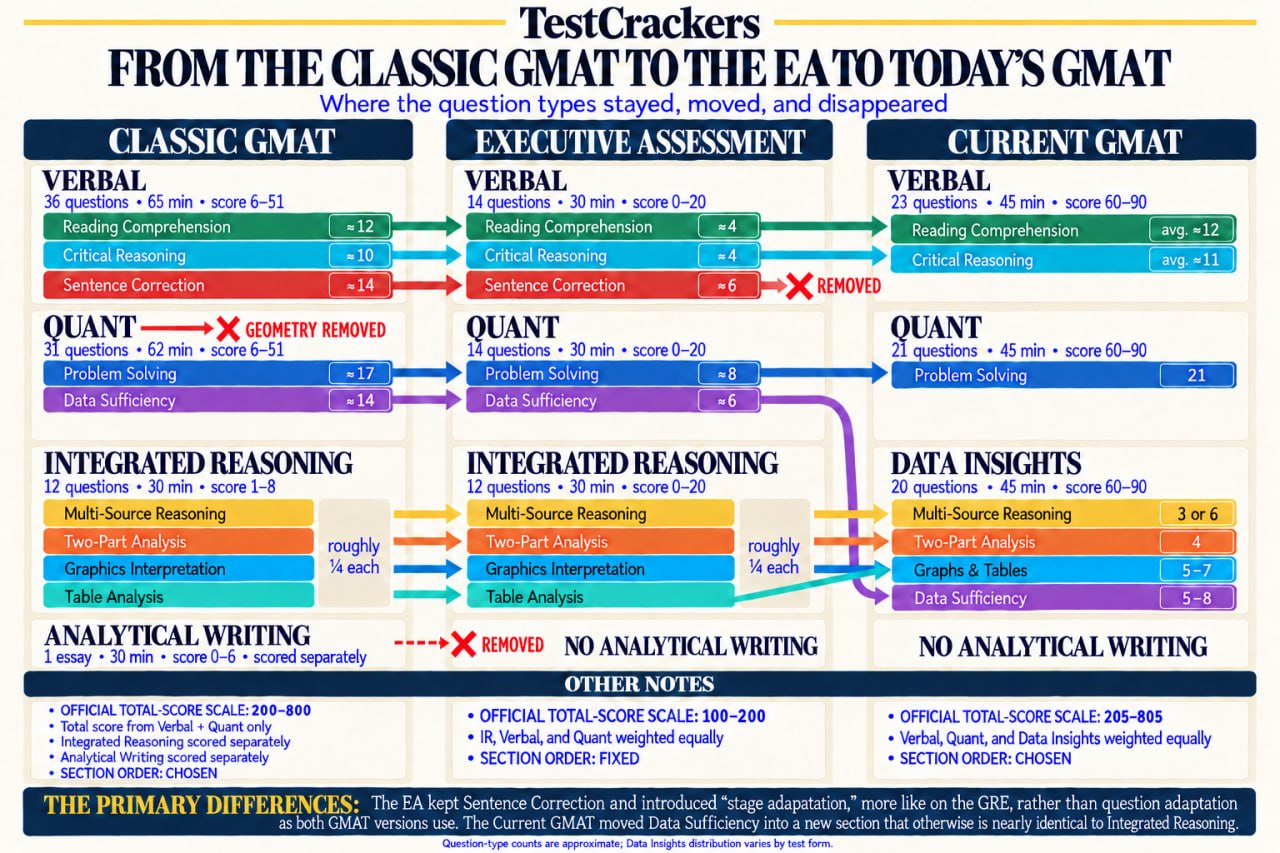
If the Executive Assessment is accepted at your target programs, it's very much worth a try as well, though for some the addition of Sentence Correction, testing grammar, can make Verbal more challenging to score competitively on. I've written extensively about the EA for MBA.com, so feel free to explore those articles on MBA.com for more on this exam.
How to Choose Between the GRE and GMAT
Reading about the differences is useful context. Taking a practice test of each is the thing that actually answers the question.
If you're genuinely unsure, take one full, timed, official practice exam of each (and of the EA, if your programs accept it) under realistic conditions. Don't study for any of them first. Just sit down and take them cold.
Then compare three things:
- Your scores relative to your target programs' medians. Look up the average GMAT and GRE scores at the schools you're targeting. How did your cold practice score compare to each median? A score that's 5 points below the GRE median but 50 points below the GMAT median is telling you something concrete. Compare your scores against top MBA programs
- How the adaptivity felt. The GMAT's question-by-question adjustment and the GRE's section-level jumps feel genuinely different in practice. Which one disrupted your performance more? Keep in mind that how a test feels on your first cold attempt will evolve as you prepare, but your initial reaction contains useful information about which format your brain is more comfortable with.
- What you'd need to study to close the gap. Look at what you got wrong on each test. Which set of weaknesses is more realistic to address in the time you have? The overlap between the tests is bigger than most people assume. Reading Comprehension, Critical Reasoning, and the vast majority of quant concepts are shared. You're not starting from scratch either way.
If you've already started GMAT prep: most of what you've done transfers. The core skills overlap significantly. You're adjusting your preparation, not abandoning it.
If your GMAT quant scores are stuck well below your target, give the GRE a serious look. In my experience, closing a large quant gap on the GMAT can be a long, frustrating process. The path to a comparable percentile on the GRE is often shorter, thanks in part to more approachable questions and section-level adaptivity. Some people also find geometry more intuitive than GMAT-style algebraic reasoning under time pressure.
"But I've heard that business schools prefer the GMAT."
Historically, GMAT scores factored into business school rankings in ways that GRE scores did not, which created some subtle dynamics in admissions. That landscape has been shifting as GRE acceptance has become universal and ranking methodologies have evolved. The practical reality for the overwhelming majority of applicants: the more competitive score wins, regardless of which test it comes from. Focus on hitting the median at your target schools, not on which test name is printed on the score report.
Making the Call
Take the practice exams, compare the results against the medians at your target schools, and the right choice usually makes itself. Fill out the form below and I'll send you links to our current recommendations for the best baseline exam to take, or, if you've already taken one, help interpreting your results and choosing your next steps. You can also use this tool to learn more about your scores. We're happy to give you free advice, whether you're looking to self-study, join a course, or get private tutoring. See our FAQ for more
Which exam is right for you?
Fill out the form and I'll send you a baseline exam link, help you interpret your results, or both.
Got it!
I'll get back to you shortly with your baseline exam links and any guidance.

Seth Capron has spent over 12 years teaching the GRE and GMAT and has helped thousands of students score their best and get into graduate school. He's a 99th percentile scorer on the GRE, GMAT, and EA, and has hundreds of five-star reviews from students. He's authored a number of articles for mba.com on exam strategy, including articles on GMAT pacing and Executive Assessment preparation, and holds an MBA from the Kellogg School of Management. He designed the TestCrackers curricula with Yuri, and he will take the analogies in these articles far further than he has any right to.
Ready to raise your score with 99th-percentile instructors? TestCrackers runs the highest-rated small-group GRE courses and 1-on-1 tutoring.
Explore GRE courses →